
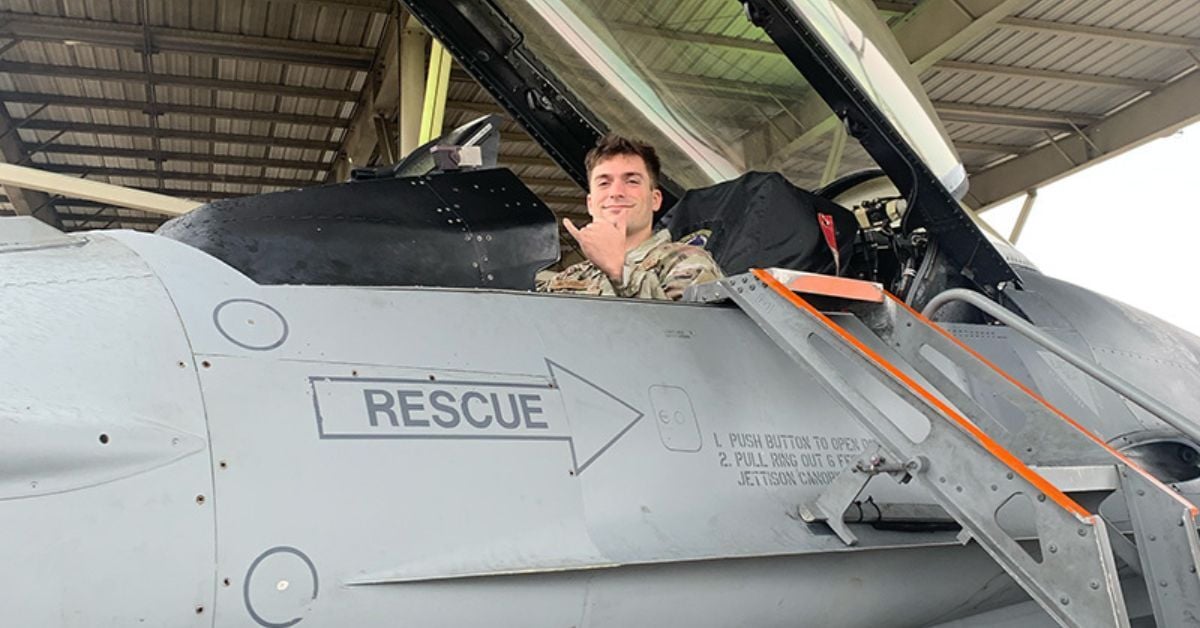
Kameron Manning’s leadership path began in the U.S. Air Force and has continued as a Siegfried Fellow at UD
Kameron Manning enlisted in the United States Air Force in 2017 and quickly advanced to president of the Airmen Council, a role in which he would hold meetings where all the airmen in his rank would voice their problems or concerns, and then brief the base commander.
“That was my first real experience of taking the needs and wants of others and seeing how I can get those accomplished from the level above,” Manning said. “So it was a process of followership into leadership, and now you have to go help others buy in as well.”
Pulling people from all over the country to come together and achieve a goal, and leading them to that goal, “that’s the most beautiful, addicting thing in this world,” he said.
Manning’s impressive leadership path began on that base in Hawaii and has continued at the University of Delaware, where he participated in the prestigious Siegfried Fellows program and was the recipient of the 2025 Siegfried Student Award for Entrepreneurial Leadership.
“I’m made by the people before me,” said Manning, a junior pursuing a degree in leadership from the Joseph R. Biden, Jr. School of Public Policy and Administration at UD with concentrations in business, operations management and entrepreneurship. “The Colonels in the Air Force, my parents, Johann (Ducharme, UD assistant professor of entrepreneurship and faculty director of the Siegfried Fellows in Horn Entrepreneurship), … it’s just a testament that the process works. When you’re a leader and you take the time to develop somebody, it will pay back if it’s done the right way.”

Manning grew up in a family where service was the expectation.
“My cousins and brothers were in the military, and that’s just what you were supposed to do,” he said. But nothing about Manning’s journey since has been merely expected.
Instead, it has been shaped deliberately: through mentors who challenged him, leaders who invested in him and opportunities that revealed not just what leadership looks like, but what it feels like.
Manning, who enlisted after graduating from high school and was stationed in Hawaii, met Lt. Col. Daniel Trueblood a year later.
“One day he showed up and asked what I wanted my legacy to be,” Manning said. The question wasn’t about tasks or performance reports; it was about purpose. From that moment, the trajectory of Manning’s career shifted. “I just trusted him and bought into all his teaching.”
Trueblood pushed Manning into opportunities most young airmen rarely see, giving him the chance to execute responsibilities far beyond his pay grade.
Manning led homeland security missions under Operation Noble Eagle and earned Superior Performer recognition for air defense exercises in Australia, Hawaii and Qatar, leading to numerous honors. He was named Headquarters Pacific Air Forces Airmen of the Year and Command and Control Battle Manager of the Year and also earned the John L. Levitow Award, the highest recognition in Air Force Enlisted Professional Military Education.
But the awards were never the point.
“Knowing that what we were doing served a purpose, and that I was able to lead others along the way — that was it for me,” Manning said.
Trueblood later challenged Manning again by suggesting he pursue becoming a commissioned officer with an official leadership role, and as that possibility required a college degree, it reshaped his vision for the future. Manning earned a spot in the Air Force’s selective Scholarships for Outstanding Airmen to ROTC program and soon found himself choosing universities. With family spread between New Jersey and Delaware, UD was a clear fit.
What he didn’t anticipate was that UD would become the next major turning point in his leadership journey.
Manning enrolled in ENTR 253: Individual Leadership, thinking the course would simply reinforce skills he already had leading high-pressure military environments. What could a classroom teach him?
Quite a lot, as it turns out.
“I was very naïve at first,” he admitted. “In the military, it’s easy; you’re called and pushed to lead. But in Professor Ducharme’s class, leadership was taught with a technical background, with a strategic mindset.”
He found himself engaged in leadership theory and was fascinated with how passionate Ducharme dove into the topics. That buy-in led him to apply to and get selected for the Siegfried Fellows, a highly selective, cohort-based 10-month immersive program for student leaders, during the 2024-25 school year.
During his time in the program Manning found not just education but exposure to executives, innovators and thinkers shaping leadership across fields. The program blended classroom insight with real-world visits, including meetings with leaders in New York City at global technology firm Cisco and the Institute of International Education.
“As a Siegfried Fellow, Kameron was eager to grow, contribute and challenge himself," Duchrame said. “He captured the essence of entrepreneurial leadership, including resilience in the face of failure and pulling in key people and perspectives. Kameron lived those principles naturally and was always the first person to lean into an opportunity, elevate a discussion or support his peers.”
For Manning, Ducharme became the civilian counterpart to Lt. Col. Trueblood as another mentor who challenged and shaped him. “He just picked up right where (Trueblood) left off,” he said.
Receiving the Siegfried Award last fall was an achievement that helped quiet any remaining doubt about whether Manning’s success in the military could translate into academic and civilian spaces.
“When I found out I won the award, a little bit of imposter syndrome went away,” he said. “I had a lot of success in the military, but now it’s paying off here as well.”
Yet even this recognition serves a greater mission: the responsibility to invest in others the way others invested in him.
“I’ve been able to lead a lot of cool people on a lot of missions,” he said. “Because they took the time to invest in me, now I’m able to take the time (with others).”
With graduation ahead and a six-year commitment back to the Air Force as part of his commissioning program, Manning’s next dream is to become a pilot. Not just to fly, but to lead.
“Pilots in the Air Force have the most outreach,” he said. “They get to fly, then they roll into command positions where they really get to lead people. And that’s ultimately what I want to do.”
When Manning reflects on how he ended up at UD, it’s tempting to chalk it up to location and coincidence. But he doesn’t buy that.
“How I really got here wasn’t by chance,” he said. “Going through the leadership major, meeting Professor Ducharme, being on the path I’m on right now … there’s a purpose.”
In many ways, Manning is the story of leadership at its best: not a title or a rank, but a process — one built on trust, mentorship and a commitment to investing in others.
“In every context — classroom, fellowship or conversation — Kameron shows up fully,” Ducharme said. “He leads with curiosity, integrity and a genuine desire to make a positive impact. I expect great things from him, and I know this award is just the beginning.”
About Horn Entrepreneurship
Horn Entrepreneurship is the driving force behind entrepreneurship education and innovation at the University of Delaware. Consistently ranked as one of the top entrepreneurship programs in the United States, it was founded and continues to be supported by accomplished entrepreneurs. The program empowers aspiring innovators, equipping them with the skills and resources needed to bring their ideas to life and create positive change in the world.
This article was written by Kevin Tritt and originally publish on UDaily.