
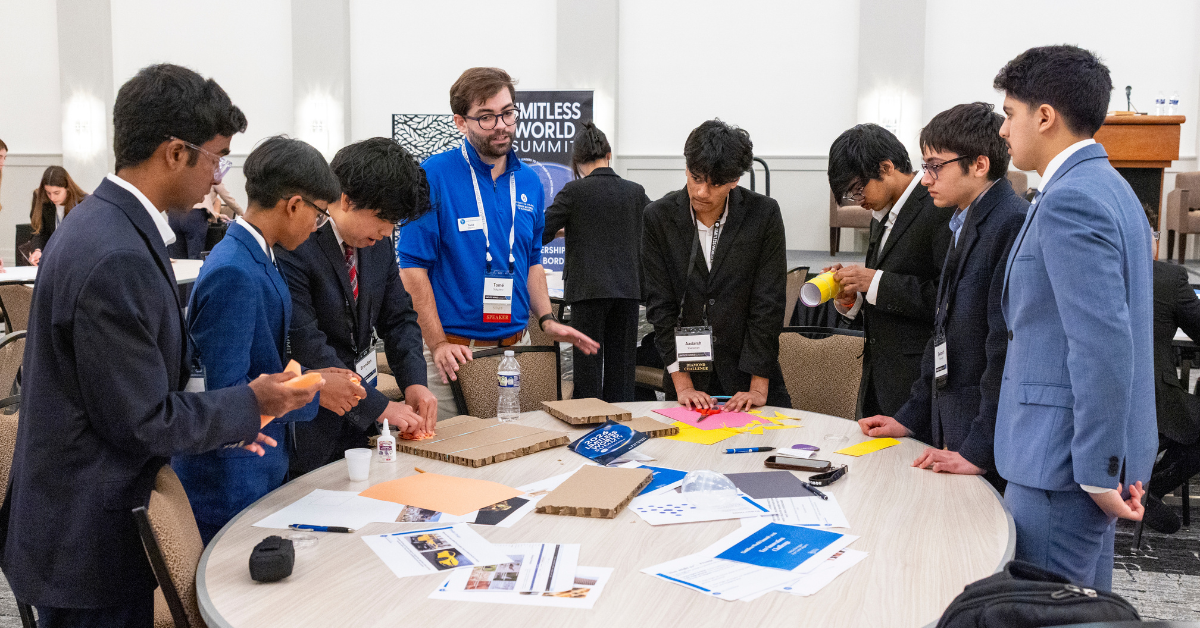
The future is often shaped by the next generation of changemakers. Based on the vision shared by the young entrepreneurs attending the 2026 Limitless World Summit, a two-day global conference hosted by the University of Delaware’s Horn Entrepreneurship at the Chase Center on the Riverfront, our future is one where businesses prioritize sustainability.
Many of the young entrepreneurs attending the summit were already tackling environmental challenges through their business and social ventures, reflecting a shared passion for safeguarding our planet. To encourage the students’ eco-conscious ideas and empower them to be catalysts for change, the summit included the Eco-Innovation Challenge, an onsite challenge that awarded students who used creativity, collaboration and entrepreneurial thinking to solve a pressing environmental issue.
“Entrepreneurship and sustainability should not be treated as separate priorities. Through the Eco-Innovation Challenge, I wanted students to see that it’s possible to design products, services and ventures that are both financially viable and ecologically responsible,” said Tomé Salgueiro, assistant professor of entrepreneurship at the Alfred Lerner College of Business and Economics and coordinator of the challenge for the past three years.
Offered on the first day of the summit, the challenge tasked students to brainstorm innovative solutions that reduced the excess waste left behind at large-scale events like concerts, festivals and conferences. Students from across the summit—including Diamond Challenge competitors, Emerging Innovator top 100 awardees and Limitless World Summit Ambassadors—formed teams to develop a prototype and presentation explaining their idea to a panel of judges. In addition to encouraging the students to view sustainability as an essential design principle for their future ventures, the challenge also gave them hands-on practice developing the problem-solving skills, creativity and quick-thinking required daily of an entrepreneur.
“I’m always impressed by how quickly students can move from ideation into communication and persuasion. … They were remarkably comfortable moving from a raw idea to a compelling pitch. Some of them sounded as if they had been preparing for weeks, when in reality they had developed their ideas in about an hour,” said Salgueiro.
Many of the teams solved the problem by designing prototypes that managed existing waste, replaced single-use products with reusable or recyclable alternatives or found new uses for discarded materials.
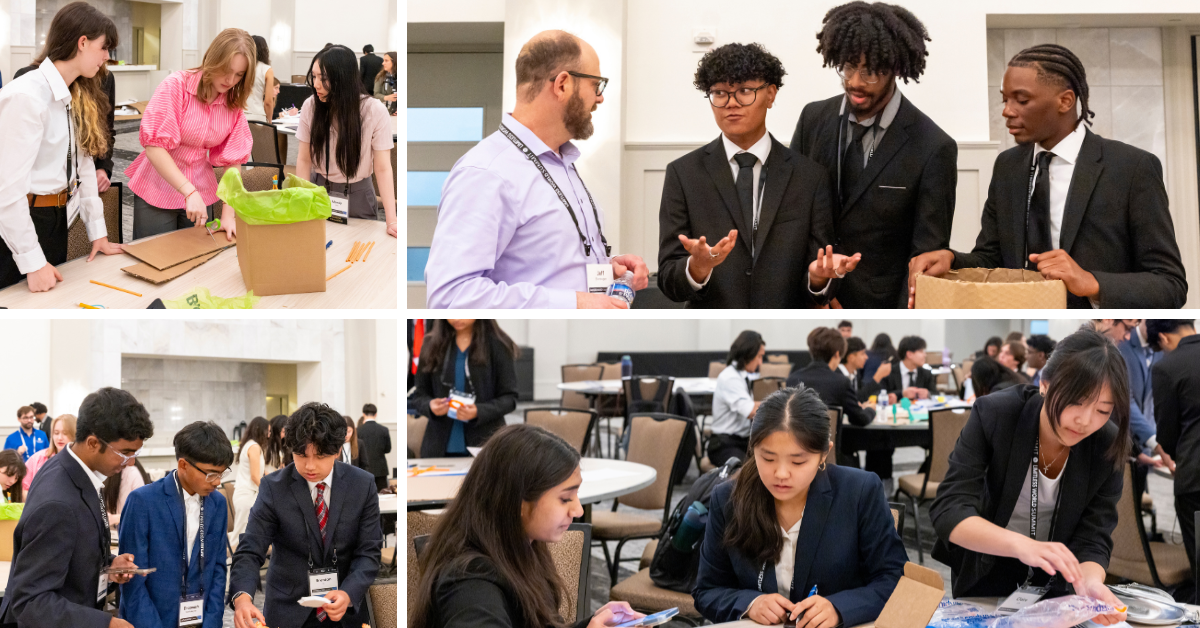
“What was particularly exciting was that they were not only thinking in circular terms, but also using biomimicry. They looked to nature for inspiration and asked how natural systems manage resources, eliminate waste and create value through interdependence,” said Salgueiro, who encouraged the students to view nature as an innovation tool.
Guided by this design principle, one team, Pollination Creation featuring students Ava Garcia, Eehan Masud, Anika Rusiya and Anwesha Kumari, drew inspiration for their prototype from the behavior of bees. Referring to the beehive as a model of efficiency, they designed a collection system in which event-goers were encouraged to pick up discarded plastic and deliver it to drop-off points for rewards — mirroring the process of gathering pollen for the beehive.
“What seemed to resonate with the judges was the team’s ability to explain how inspiration from nature could lead to a more thoughtful and sustainable approach,” said Salgueiro.
In addition to practicing innovation and presentation skills, the challenge gave Rusiya, a 15-year-old member of Pollination Creation from New Jersey, the chance to grow personally. Although her Diamond Challenge team didn’t advance to the final pitching round, Rusiya attended the summit as an ambassador to prepare for next year’s competition. When she joined the onsite Eco-Innovation Challenge, it was part of her efforts to push herself outside of her comfort zone.
“I’ve never experienced something like this before as a freshman. I feel like we’re always encouraged to meet new people and, at the summit especially, I’ve actually taken that step and made new friends instead of sticking with the same people,” said Rusiya, whose quick connection with her new teammates led them to win the challenge and earn a $1,000 prize each at the award ceremony.
After witnessing how the teams translated observations from nature into entrepreneurial ideas in the challenge, Salgueiro hoped the students were starting to view nature as a teacher with valuable lessons to share after refining natural solutions for billions of years.
“There is sometimes a concern that younger generations may be less connected to nature, but what I saw in this challenge suggested something different. These students clearly had something to say, and more importantly, something they wanted to do about it. That matters because the businesses of the future will need to be designed differently,” said Salgueiro, who trusts this generation will use entrepreneurship to benefit both people and the planet.
ABOUT HORN ENTREPRENEURSHIP
Horn Entrepreneurship serves as the creative engine for entrepreneurship education and advancement at the University of Delaware. Currently ranked among the best entrepreneurship programs in the U.S., Horn Entrepreneurship was built and is actively supported by successful entrepreneurs, empowering aspiring innovators as they pursue new ideas for a better world.