
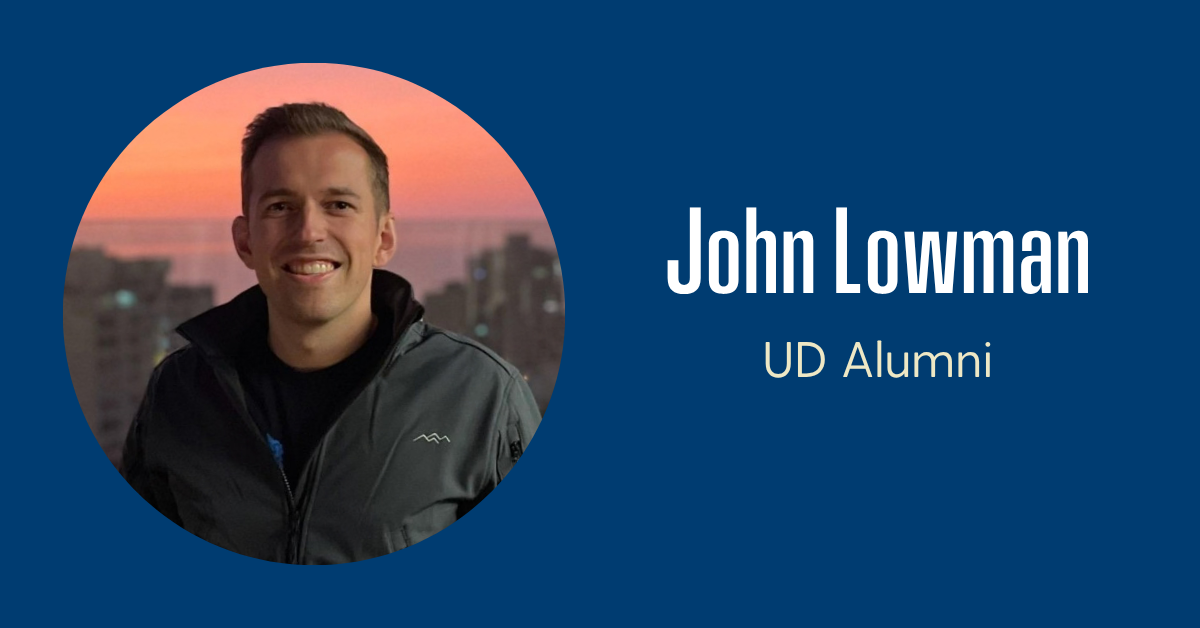
From launching a senior design capstone project as an entrepreneurial pitch to building a career bridging academic innovation and corporate venture capital at UPMC, John Lowman's journey highlights the impact of the Horn Entrepreneurship ecosystem at the University of Delaware. In this feature, John reflects on his winding career path, key lessons in customer discovery, and the power of strategic listening.
From launching a senior design capstone project as a startup pitch to building a career bridging academic innovation and corporate venture capital at UPMC, John Lowman's journey highlights the impact of the Horn Entrepreneurship ecosystem at the University of Delaware. In this feature, John reflects on his winding career path, key lessons in customer discovery, and the power of intentional listening.
You came to Horn late in the game. What pulled you in?
Late is generous! I’d only heard about Horn Entrepreneurship during the second half of my senior year, and had no idea the impact it would have on my personal and professional trajectory. It started with our senior design capstone course: me and three brilliant friends, Daniel Charytonowicz, Elizabeth Soulas, and Allison Lisberg, built a closed system to safely dispose of leftover narcotic waste at hospitals, working closely with clinicians at Nemours.
When the formal engineering course wrapped up, my teammates proposed taking the concept further by applying to Hen Hatch. Beyond early seasons of Shark Tank, I had no idea what a pitch competition entailed, and dreaded public speaking at the time. But the more uncomfortable something makes you, the more you’ll grow (and the better stories you’ll get) so I went along for the ride. We applied, made the semifinals, and suddenly had to answer a question none of us had really asked: what business could you actually build around our brave little trashcan?
I’ll never forget during that pitch, our slide deck completely crashed, and we had to riff acapella about narcotic chains-of-custody and ramen spectroscopy. We figured we were toast, but the judges saw something in us and invited us to pitch in the Finals. We left Hen Hatch with a massive initial investment from Horn and, equally important, an invitation to join the first cohort of the Summer Founders program.
How was that first Summer Founders cohort?
Vince DiFelice and the team really whipped us into shape that summer - we were used to long hours from engineering, but spending 10+ each day on a venture is a completely different beast. So much of it is open-ended learning, getting in front of potential customers to truly understand what they’d pay to change. That period was intense, and we learned firsthand the dedication required to run a proper customer discovery process.
That said, it was always more fulfilling than exhausting, and I’d have to attribute that to the encouragement and mentoring from the entire Horn team, as well as the opportunity to work alongside other incredible UD founders. Grinding and making memories with our friends at GeoSwap, CuringCube, TenantU, Reviresco, Lazarus Rising, and TheraV was such an invaluable part of the JADE story.
After running all the potential product permutations to ground against what we’d learned from customers, it ultimately became clear that the economics of our solution were not commercially viable for hospital systems. I do still think that someday our envisioned solution will exist - the need is certainly there, we just need a more streamlined technology to answer it!
Talk about your work at Mimetas.
Working at Mimetas was an incredible experience. It is a Dutch biotech startup that develops micro-scale models of human tissues(miniature livers, kidneys, and brains), that replicate key physiological features of target organs in a compact format. This technology allows researchers to conduct complex parallel biological experiments without the need for animal models or sacrificing experimental complexity.
At Mimetas, our team engaged with various biotech and pharmaceutical companies, deploying the platform to test therapeutics and support drug discovery prior to clinical trials. My role centered on business development, specifically cultivating commercial partnerships primarily with U.S.-based pharmaceutical firms.
It was a phenomenal growth journey, both personally and organizationally. When I joined, the company comprised roughly 25 employees; by the time I transitioned out, that number had grown to around 100. Operating in a smaller team environment, particularly on the U.S. side, allowed me to wear many hats and collaborate closely with our headquarters in the Netherlands. I formed enduring international friendships through that role, and I always encourage early-career professionals to seek out opportunities at ambitious, growing enterprises.
How did your past positions lead you to becoming part of UPMC Enterprises today?
After spending nearly five years with Mimetas, the post-COVID era prompted me to relocate closer to Pittsburgh. I had a specific interest in translating academic innovations from local research institutions into viable spinout companies or licensing opportunities for major pharmaceutical and biotech partners.
While I was looking to leverage my background while returning home, I was not yet familiar with the specific opportunities available at UPMC Enterprises. In Pittsburgh, UPMC is an iconic institution recognized worldwide for its clinical excellence and extensive health system. However, I discovered that its corporate venture arm operated on a different level entirely.
My current role focuses heavily on managing sponsored research partnerships within university laboratories. We commit capital to accelerate emerging technologies, funding the critical validation experiments that venture investors and industry partners require prior to licensing or spinning out a company. We serve as a strategic bridge and capital partner, helping advance promising therapeutics out of the academic lab and toward clinical testing, alongside our traditional venture investment activities. It is a fast-paced environment where every day presents new intellectual challenges.
Talk about the biggest learning curve that you’ve had to ascend
Ah yeah for me, the steepest learning curve was building up enough scientific fluency to hold my own in highly technical, consultative partnership discussions. My first year at Mimetas, working shoulder-to-shoulder with drug developers, truly felt like it required learning a foreign language. Luckily I did have some awesome foundational training for this in UD Biomedical Engineering (shout out to Dr. John Slater's cellular engineering class!) but as always, there’s so much that just has to be learned by doing..
Speaking of impactful classes, I’d also have to give a ton of credit to Horn’s sales training course led by Ted Fulton at the time - my friend and colleague Janty and I were fortunate enough to audit post-graduation, and so many of those lessons resonated in the field. As we learned in the course and was so clear firsthand, simply reciting the features of your offering is never enough to close actual business partnerships. Instead, true effectiveness requires slowing down, actively listening, and articulating the precise priorities and needs of a partner. Deliberately listening for the gems, for what’s really important, transformed my ability to deliver for Mimetas and our partners and has been universally applicable across my career (and life!).
What is the proudest moment of your career?
You know, my proudest moments are the cherished memories shared with colleagues and mentors that are the foundation for life-long friendships. Wiser folks than me have said that it’s more about who you spend the adventure with than where you end up, and I’m so proud of all the ultra-talented friends I’ve got to grow with in my early career. And knowing that these relationships last a lifetime just fills me with so much gratitude.
How did UD and Horn entrepreneurship shape your path to where you are today?
Oh honestly, I can’t really overstate the impact that Horn Entrepreneurship has had on my career trajectory. The been there, done that mentorship at Horn really helped me raise the ceiling on my career ambitions, and aimed me towards highly fulfilling work in venture development and entrepreneurship. Immersive programs like Hen Hatch and Summer Founders delivered just as much self-discovery as they did customer-discovery, and really gave me the chance to see (and believe) what small, dedicated teams can achieve.
Before those experiences, I assumed that entrepreneurship, charting your own course in the world and making an impact, was an unattainable daydream - something reserved for others, not me. The mentorship of Vince and the entire coaching community dismantled those self-limiting barriers brick by brick, and I can’t thank them enough for that.
What advice would you give a current student who's thinking about launching a startup but doesn't know where to start?
My main piece of advice is simply to begin. If you’re waiting for the absolute perfect moment to take a leap of faith, it’s never going to arrive on its own; instead, you make the moment perfect by choosing to take the leap. Pivots can be things of beauty, and that fundamental insight that unlocks a huge success often only reveals itself once you’re dived in with both feet. So just get started already and see what you learn!"
John and his team at UPMC Enterprises are currently engaged in a wide array of exciting initiatives. His primary focus remains on collaborating with colleagues to advance meaningful medical innovations, and he continues to thoroughly enjoy the work they are building together.
From his early days tackling a senior design capstone to the foundation forged through Horn Entrepreneurship, his journey stands as a powerful testament to the lasting impact of hands-on entrepreneurial education.
ABOUT HORN ENTREPRENEURSHIP
Horn Entrepreneurship serves as the creative engine for entrepreneurship education and advancement at the University of Delaware. Currently ranked among the best entrepreneurship programs in the U.S., Horn Entrepreneurship was built and is actively supported by successful entrepreneurs, empowering aspiring innovators as they pursue new ideas for a better world.