
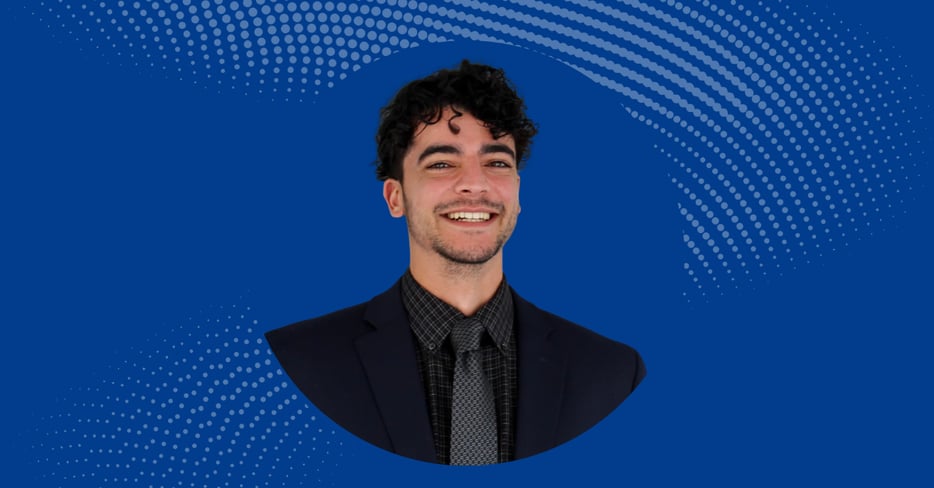
Darian Elmendorf’s path as a founder began with a deeply personal mission: making mental health support more accessible, relatable and sustainable. As he returned home to restart the project years ago, he turned a broad mental health group landscape into a specialized workforce development firm through Polaris Pathways.
Elmendorf, a University of Delaware alumnus with a B.S. in entrepreneurship, built Polaris from lessons first learned through campus-based peer support work. With professionalism, empathy and consistency, his work supports community health organizations with peer-to-peer support by training people with lived experience to become certified peer support specialists.
The mission stands as a testament to the power of integrating real life experiences with professional expertise to maximize the impact of community-based support. With training, certifications, consulting, and custom software development, Polaris Pathways equips organizations, treatment centers and nonprofits with the tools to create a successful community network.
What inspired Polaris Pathways?
In my undergrad, I initially aimed to combine my interest in the music industry with mental health advocacy. I wanted to work in music festivals to raise awareness, but that experience led me to a much more sustainable and impactful discovery: the power of peer-to-peer support.
After participating in Horn Entrepreneurship’s Summer Founders program, I continued building the idea while balancing several part-time roles. I spent my time working with the state, the university, and local nonprofits like the UnLocke the Light foundation at Sean’s House, all while trying to build my startup. I built relationships across multiple fields while also burning cash on my business. In 2023, I hit a wall and faced a difficult co-founder transition.
I decided to move back to New Jersey to restart from scratch, taking the best of what I had developed: a robust training program for Certified Peer Specialists. I shifted my focus from a broad 'mental health group' to a specialized workforce development firm that brought Polaris to life. Partnering with a new colleague to solve the funding issue was the turning point of Polaris, securing workforce development scholarships in Colorado to solve the employer talent shortage. Now, in the past 18 months, it has been the most successful time of my career. Today, we have trained over 200 specialists, with a new cohort of 60–70 students launching this week. After years of trial and error, the transition from survival to sustainability has been extremely rewarding.

How did your early work at UD and Friends 4 Friends shape the idea?
My experience as the Events Director at Friends 4 Friends provided an early roadmap for what Polaris came to be. As a team, we realized that peer support really does work on campus, and its delivery truly matters.
One of the most significant insights I gained was the fear many college students have about using university services. Many students avoid official resources for fear that a mental health crisis might lead to academic suspension or sanctioning.
This directly influenced our decision to prioritize secure and private access within our technology. We realized that for peer support to be effective at scale, the software had to offer a secure, independent access to avoid the institutional oversight, ensuring students feel safe to share without fear of academic or personal repercussions.
When researching the national landscape, I saw that existing tools often lacked that specific 'peer-to-peer' experience that is a more comfortable option for the students we were trying to reach. We built our framework to facilitate those specific connections, ensuring the technology didn't get in the way of the authentic, relatable moments that make peer support work. This is what I brought with me to Polaris, as those who can relate to similar challenges are now the trained specialists.
We realized that if we could use technology to be a training platform and manage the peer workforce, we could support thousands of students through the organizations that hire them from anywhere. Today, Polaris Pathways focuses on solving that barrier, ensuring that there is a repeatable, scalable way to help those who are struggling to find employment and support.
What changed when you moved from student advocacy to a formal organization?
Helping to build Sean’s House with UnLocke the Light was a pivotal chapter in my career. Moving from a student-led initiative like Friends 4 Friends to a formal non-profit organization was a big step in professional responsibility and campus-wide operational scaling.
It was not only a challenge to step into a new role; the stakes were also much higher. In a student club, you are primarily focused on awareness and community building. At Sean’s House, I was the Head Director of Peer Support. This meant transitioning from volunteer coordination to workforce management. I had to oversee training, planning, scheduling, and on-campus support, ensuring that we had coverage. Also, in a 24/7 environment, peer specialists needed to be equipped to deliver a consistent, high-quality service for all students.
Being part of a recovery journey that would have helped my own mental health growing up, while also carrying the weight of leadership, was one of the biggest hurdles of my career. I learned that in order to protect our organization’s reputation, the safety of our guests in a professional support environment had to be the priority. It wasn't just a hobby anymore; it was a legitimate enterprise with a reputation to uphold. That experience taught me that in the mental health space, consistency is just as important as empathy.
This transition is exactly what I’ve carried into Polaris Pathways. I took those lessons in risk, operations, and professional standards and applied them to a scalable model that helps other organizations provide empathy in a sustainable way.
How do you balance mission and sustainability?
The industry is rapidly moving toward a value-based care model. If an organization cannot prove its services are actually helping people, it lacks a sustainable foundation. Data and technology cannot replace human-to-human connection. At Polaris Pathways, I balance our mission with multiple key components:
For me, sustainable growth means ensuring that our product, our training, and our certifications can actually deliver a meaningful transformation. We don't just track completion rates; we listen to student feedback and employers’ needs to evolve based on community feedback.
Organizations need evidence, funding and operational structure to function. Customer value, professional efficiency, and development has always been the focus. Bridging the gap between supporting others and being sustainable is an evolving need.
Another key component of building Polaris has been the use of technology. Data, technology and AI are support systems that help make our jobs more efficient. AI has helped review finances, provide student support, and manage administrative tasks without a massive team. This makes it a strong tool that can be seen as a digital co-founder of any company today.
What has been your proudest moment?
My proudest moment wasn't a financial milestone; it was much more personal. During my time at Sean’s House and UnLocke the Light, I had parents walk in, overwhelmed with emotion, to share that their child had spoken with me or one of our peers and was finally taking steps towards recovery. Hearing someone say that a conversation helped pivot their child’s life was a perfect reminder of why we do this.
When I started, my goal was simply to help one person. Seeing those programs grow to support thousands of people today is a constant reminder that the work we do at Polaris Pathways isn't just about training; it’s about providing that support for anyone in need, and expanding organizations across the world that support people in their community.
A critical part of this mission is addressing why people often hesitate to reach out to traditional university services. By building systems centered on peer-to-peer connection, we help students feel more comfortable seeking support in a setting built around trust, privacy, and shared experience. At the end of the day, we are creating frameworks that facilitate meaningful human connections, and that is what makes the work worth it.
How did Horn support your founder journey?
The University of Delaware and Horn Entrepreneurship provided the foundation I needed to transition from a passionate student advocate to a professional CEO.
As an undergraduate, UD offered me the flexibility to bring my real-world mission into the classroom. Rather than working on hypotheticals, I applied course concepts directly to the mental health initiatives I was leading on campus. It taught me that entrepreneurship isn't just about having an idea to make money; it’s about having the discipline to apply business science to a problem you are deeply committed to solving.
That support continued after graduation. In 2023, I participated in the NSF I-Corps program through Horn, which was a turning point for my long-term vision. It was through this program that I met a mentor I still consult with weekly. He has been instrumental in pushing me to look beyond our current success as a training company and toward a larger vision of systemic change through software and consulting.
UD and Horn have significant resources, mentorship and academic environment that helped me build the foundation for Polaris Pathways. I am a firm believer that the "entrepreneurship science" I learned here is what allowed me to navigate the pivots and ultimately achieve the sustainable growth we see today at Polaris Pathways. Being able to take my personal recovery journey into a scalable, professional enterprise has been a long and rewarding journey.
What advice would you give students?
My advice to students is simple: Focus on the skills that cannot be replicated and embrace the tools that can. AI is rapidly automating technical execution and raising fear about job replacement, whether in finance, coding, or administrative tasks. However, it cannot create genuine passion and a strong business vision. That is where real soft skills come into play. Leadership, creativity, and design are exponentially valuable human skills that AI can’t replicate. Identifying a meaningful problem and developing a solution that helps people has to come from people.
Students no longer need a massive budget or a full engineering team to start testing an idea. Today, you can build a prototype with a single prompt. My advice is to stop planning and start shipping. Use AI to build a landing page, create a prototype, and start testing and getting traction. This allows you to get fresh eyes on your idea almost immediately. If it fails, you’ve lost ten minutes, not ten months. This speed allows you to iterate and pivot until you find a product that the world needs.
However, you have to be willing to put yourself out there and fail. If you have a gut feeling that your idea is going to sell, and it will solve many people’s problems, put it out there and see where it lands. That is my advice to them.
For Darian, entrepreneurship has become a way to turn lived experience into systems-level impact. What began as campus advocacy has grown into Polaris Pathways, a company helping organizations build stronger, more sustainable peer-support networks. His story is a reminder that some of the most powerful ventures begin with a personal mission and grow through persistence, focus and the willingness to pivot for good.
ABOUT HORN ENTREPRENEURSHIP
Horn Entrepreneurship serves as the creative engine for entrepreneurship education and advancement at the University of Delaware. Currently ranked among the best entrepreneurship programs in the U.S., Horn Entrepreneurship was built and is actively supported by successful entrepreneurs, empowering aspiring innovators as they pursue new ideas for a better world.